Now here’a a first. After musicals based on films and tv shows, here is one based on a radio programme. It was a documentary by Charles Chilton which used people’s memories of the First World War, interspersed with facts, statistics and songs of the period. A lot of the numbers were either hymns or show tunes with words changed by the soldiers in the trenches, to convey their thoughts at the time. Needless to say, some of the lyrics were rather raucous, as well as being humorous or melancholy. We British are the world’s leading exponents of both understatement and irony, which is probably why the Americans feel the need to rewrite the comedy series they buy from us, but those two elements, when used in a context such as this, can be as lethal as the whizz-bangs which killed hundreds of thousands of young men on the Western Front.
The show was first staged in March, 1963 at The Theatre Royal, Stratford East by the Theatre Workshop, a company run by the formidable Joan Littlewood. She had strong views on many things, some of which led to the success of the project. She thought that the actors should be involved in the creation of the works in which they performed, so, after reading the script, in this case by the aforementioned Charles Clinton and Gerry Raffles, she would allow the players to improvise to create a final version. Her modus operandi was to give each of the thespians a theme within the play to research and write about, in this case, gas or a particular battle, and then throw it open to everyone for their input, producing a finished work. Creativity by committee is rarely a good thing, but here is was structured chaos and succeeds admirably.

Clockwise from top left: Euan Wilson, Harry Curley, Tom Crabtree, Christopher Arkeston (replaced by Tom Benjamin from January, 2024), Alice E Mayer and Chioma Uma.
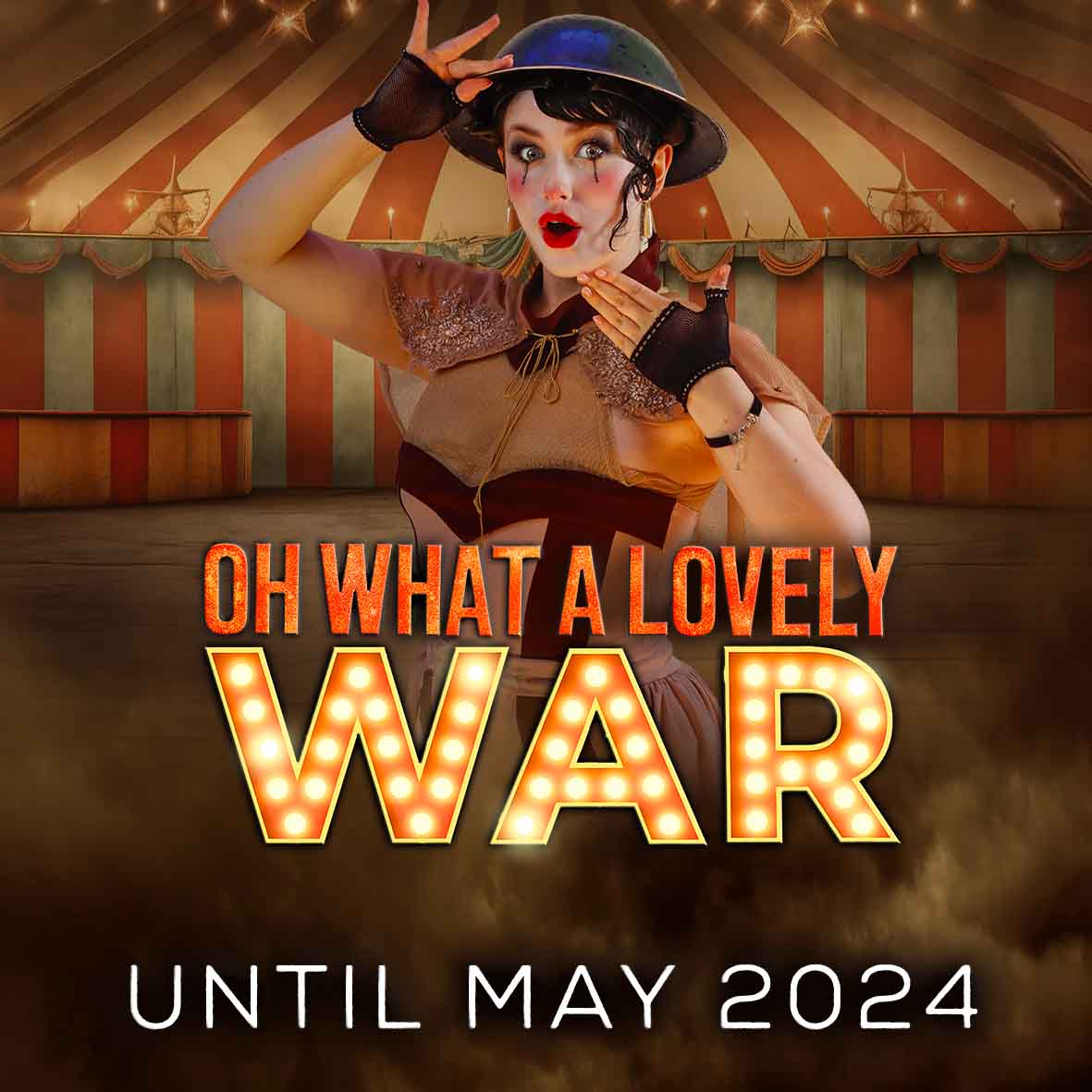
Ms Littlewood, who hated the colour khaki, and war – not great for someone creating a play on this subject – stipulated that the cast wear more light-hearted costumes. The solution was to stage the drama as a Pierrot Show with the clown attire topped with tin helmets for contrast. This means that the whole evening is like a night at the music hall, with the audience encouraged to sing along and generally behave as they would have done in the City Varieties in 1914. A kind of cross between The Good Old Days and Apocalypse Now.
The set remained the same all evening, mainly doubling as a Vaudeville venue and a trench on The Front. This was perfect as it conveyed the confines of a theatre, which it obviously was, with the claustrophobic atmosphere of a dugout. The lighting was mostly subdued which intensified the feelings, it also struck me as a poignant juxtaposition that the entertainment premises would have been lit by gas, a variant of which would have been used to kill those in battle. A section at the top of the set was used to display projected images of war, advertisements of the time and, most dramatically, pertinent statistics about the conflict, notable examples of which were: ‘Sept 25….Loos….British loss 8,236 men in 3 hours….German loss nil.’ and ‘Average life of a machine gunner under attack on the Western Front: 4 minutes.’
If you have seen the film then forget it as this production, rather than having a cast of thousands, most of which were the top actors of their time, has six performers, each playing multiple roles, and instruments.

Despite the subject matter and stats, there was obviously a lot of humour involved. I was worried that it was going to take the form of farce, but thankfully it was mainly parody and satire. There was the odd daft scene as that is how the upper classes, who provided the bulk of the officers, and the foreign soldiers were portrayed at home, but even the enemy was treated with a degree of sympathy as they were being used in the same way by their hierarchy as our Tommys. This was illustrated by the exchange of gifts on Christmas Day between the two sides’ combatants.
It must be remembered that this is a blatant anti-war play and, as such, deals with caricatures and oversimplifies the background and motives to prove its point, but it is a wonderful piece of evocative theatre which was surprisingly uplifting, despite ending at a point before the conflict did, so no victory celebrations or even an explanation as to what led to the armistice.

The singing, dancing, acting and comedic prowess of the cast ensured that the audience was fully involved, although it is quite difficult to clap whilst taking notes. The players were; Tom Benjamin, Tom Crabtree, Harry Curley, Alice E Mayer, Chioma Uma and Euan Wilson. The Director, Nicky Allpress, Musical Director, Ellie Verkerk and Movement Director, Adam Haig, led the Creatives.
Oh What A Lovely War is a Blackeyed Theatre production and, although only at Leeds Playhouse until 27th March, is touring until May. It has local(ish) stops at the Hippodrome, Darlington on 28th and 30th March, as well as Theatre Royal, Wakefield on 30th April and 1st May. For full details of the company, their other shows, and to book tickets please go to https://blackeyedtheatre.co.uk/
To see what is coming to Leeds Playhouse it is https://www.leedsplayhouse.org.uk/whats-on/
All images provided by Leeds Playhouse. Feature image from Blackeyed Theatre.
As a footnote I would just like to add that the First World War didn’t end for the soldiers involved when they got home, it very rarely does after any conflict, and my granddad was no exception. If you look at the baby photo which adorns the How Do page on this website, you will see that I am wearing his flat cap whilst enjoying my first pint. Because of the setting I always assumed that he was partial to a brew himself, he died when I was five so I couldn’t ask him myself, but years later my mother told me that he had been gassed in the trenches, the after effect was that, when he had his demob drink, his head swelled to about twice its normal size and he was informed by the doctor that any further alcohol could prove fatal. What a reward!

